How It Works
Five independent reviews.
Each focused on one compliance domain. Each forming conclusions blind to the others.
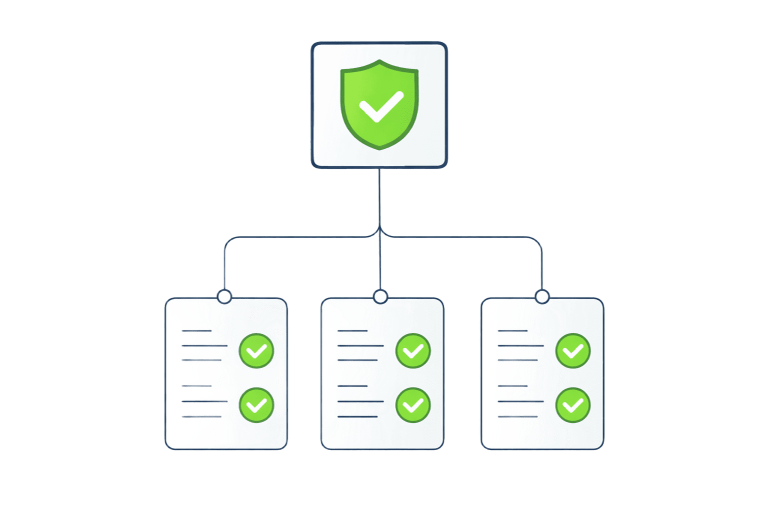
The final validator cross-examines all five before anything reaches the report.
No individual practitioner works like that. No standard process examines every requirement at that level of independence.
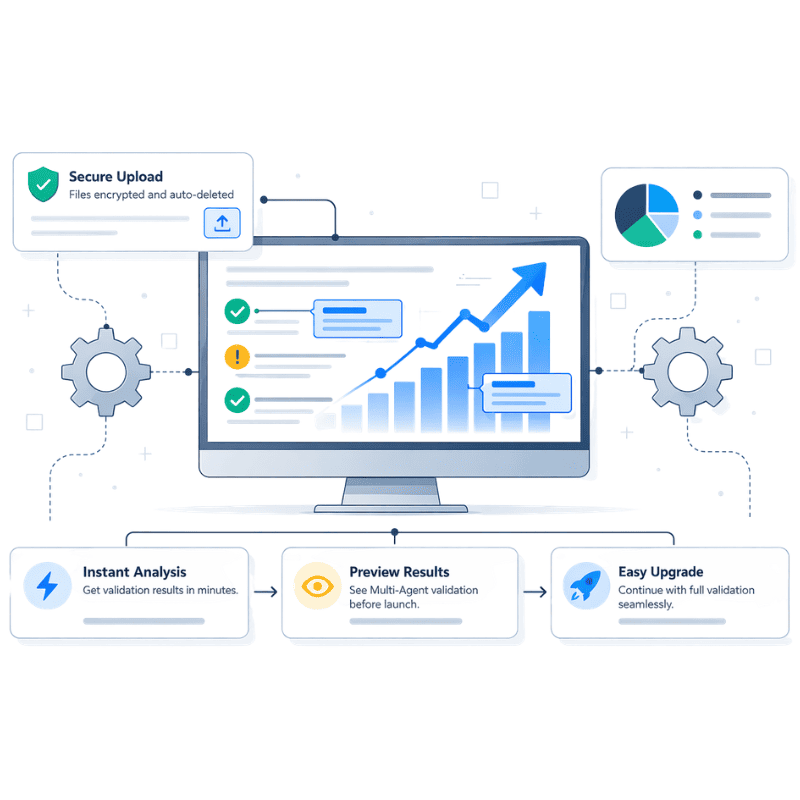
Uploading Your Assessment Tools
From upload to report: minutes, not days.
Submit the trainer and assessor guide(s) for the unit being validated — the practitioner-facing document that contains the assessment tasks, observation checklists, marking guides, model answers, and assessor instructions. However many files make up that package for a given unit.
That’s the entire input. No configuration. No manual mapping. No setup.
How Validation Is Applied
Five independent reviews
Validation360 pulls the complete, official Unit of Competency directly from training.gov.au. From it, the system constructs a hierarchical compliance benchmark.
Every element. Every performance criterion. Every nested sub-criterion. Every knowledge evidence sub-bullet. Every foundation skill, performance evidence requirement, and assessment condition — each decomposed into an independent test point.
Five independent reviews then run in parallel against the submitted assessment materials.
Every compliance requirement examined
Every requirement checked. No sampling. No assumptions. No spot checks. Gaps are not missed because they fell outside a sample.
Cross-checking designed to surface hidden gaps
The objective is not speed alone. It is consistency and rigour — so the outcome is defensible.
Why This Stays Consistent
No fatigue
The same rigour applied to the first unit reviewed and the fiftieth. Validation quality doesn’t drop as volume increases or as the year gets busier.
No familiarity bias
The units a team knows best are the ones most likely to carry blind spots. Familiarity and genuine independence are structurally incompatible. The system has no prior relationship with the tools.
No pressure to make it pass
Where deadlines or workload pressure exist, validation can drift toward close enough. The same standard is enforced every time, regardless of timing or context. No softened findings.

No single reviewer or interpretation
Five independent reviews run before the final validator cross-examines all five — each review blind to the others. Instead of hinging on one reviewer’s judgement or one consultancy’s interpretation of the Standards, conclusions are cross-confirmed from multiple independent angles before anything reaches the report.
What the System Identifies

Role-mix errors
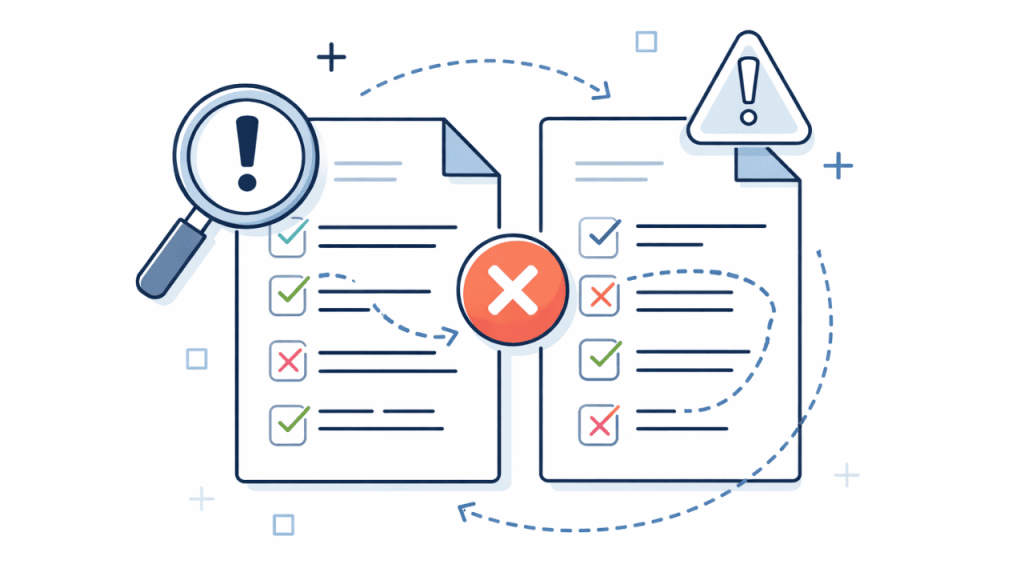
A performance criterion requires a learner to physically perform an action. The assessment task only asks them to explain, describe, or identify it.
The task exists. It maps to the right criterion. It looks like evidence.
Under ASQA’s evidence hierarchy, demonstrating knowledge of a procedure is not the same as demonstrating performance of it.
Role-mix errors are among the most consistently present failures across all qualification areas — and among the least frequently caught by internal validation.
Mapping inconsistencies
Knowledge evidence items in the UoC are frequently structured with nested sub-requirements.
Internal validation maps at the heading level. The heading gets a question, and the sub-bullets are assumed covered.
Each sub-bullet is a discrete requirement. They often aren’t covered. Validation360 treats each one independently.
A question asking a learner to define informed consent, dignity of risk, or mandatory reporting satisfies none of the knowledge evidence requirements that follow from the definition.
The UoC requires demonstrated understanding of application in practice, impact, and consequences. A definition question tests recall.
The gap is invisible on a surface read — because a question exists for every knowledge area.

Evidence and benchmark gaps
A UoC may specify performance with clients (plural), a range of equipment, at least three different situations, or on multiple occasions.
Every one of those specifications is a discrete compliance requirement.
Assessment tasks requiring a single demonstration against a plural or range requirement are non-compliant — regardless of how many delivery cycles the tool has been through.
Observation checklists not broken down per performance criterion, and marking guides without observable behaviour descriptors for practical demonstration, are also identified here.
ASQA will ask how the assessor determined competence. Most checklists cannot answer that question.
Questions We Hear From Compliance Teams
What You Receive
What the system finds, the report makes actionable.
Every finding traced to a specific task, criterion, or evidence requirement — so the work that remains is the fix, not the analysis.
The compliance status dashboard
Five colour-coded domain charts — green, yellow, red. Showing the proportion of requirements that Fully Map, Partially Map, or Do Not Map. One view of the risk profile across all five compliance domains, readable in under a minute.

Clear rectification guidance
Every finding traced to an exact task number, question reference, or form identifier.
Every recommendation specific to the gap it addresses.
The analysis work lifts. What’s left to do is the fix — requirement by requirement, task by task, where practitioner judgement actually matters.
Professional, RTO-branded, audit-ready reports
Delivered in minutes. Branded to the RTO. Formatted and ready for internal compliance records and validation evidence.
The full report includes a requirement-by-requirement analysis across all three evidence dimensions, a dedicated assessment conditions analysis, and a cross-reference matrix mapping every performance criterion against every form of supporting evidence on a single page.